Hydrogen (H2) activation is a fundamental elementary step in a wide range of energy and chemical processes, including hydrogenation catalysis, ammonia synthesis, petroleum refining, and fuel cells. Platinum (Pt)-based catalysts are widely used in hydrogenation reactions because of their excellent ability to activate H2. However, conventional Pt-catalyzed hydrogenation processes often require elevated temperatures to achieve efficient conversion. Developing strategies for efficient H2 activation under mild conditions therefore remains an important challenge in catalysis. In recent years, plasmonic enhancement has emerged as a promising approach for light-driven H2 activation. However, most of works have relied on ensemble-averaged measurements of plasmonic nanoparticles, making it difficult to directly resolve localized reaction behavior at individual plasmonic hotspots. At the same time, the migration and propagation of activated hydrogen species across catalyst surfaces remain poorly understood and lack direct nanoscale experimental observation. Directly visualizing plasmon-enhanced H2 activation at the nanoscale and elucidating how activated hydrogen species are generated, migrate, and propagate over extended distances are therefore crucial for understanding plasmon-mediated catalytic processes.
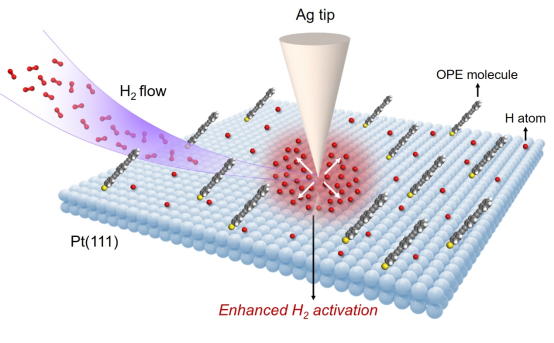
To address these challenges, Prof. Zhen-Feng Cai from the College of Chemistry at Sichuan University, in collaboration with Dr. Naresh Kumar and Prof. Jeremy O. Richardson at ETH Zürich and Prof. Yao Zhang at the University of Science and Technology of China (USTC), investigated plasmon-enhanced H2 activation at the nanoscale. The team employed tip-enhanced Raman spectroscopy (TERS) with a thiolate molecule, OPE, as a molecular reporter. By combining high-resolution TERS imaging with finite-element method (FEM) simulations and quantum-chemical and density functional theory (DFT) calculations, the researchers achieved nanoscale visualization of plasmon-enhanced H2 activation in the Ag tip–Pt(111) nanocavity and further tracked the long-range migration of activated hydrogen atoms across the Pt(111) surface.
The study reveals that localized plasmonic hotspots generated under visible-light excitation substantially enhance H2 activation on Pt(111), producing a localized region of enhanced activity extending approximately 180–300 nm around the hotspot. Within this region, H2 activation was enhanced by approximately 20% relative to the surrounding surface. Further experiments demonstrated that the spatial extent of the activated region could be tuned by varying both the H2 exposure time and laser excitation intensity. With an H2 exposure time of only 5 s, the localized molecular desorption region was approximately 75 nm in diameter, whereas increasing the laser excitation power expanded the region to approximately 600 nm.
To distinguish the contributions of photothermal and hot-carrier effects to H2 activation, the researchers performed FEM simulations together with a series of control experiments. The simulations showed that laser irradiation produced only a milli-kelvin-scale local temperature increase, far below the temperature required for thermally induced Pt–S bond cleavage. These results rule out photothermal heating as the primary origin of the localized enhancement in H2 activation. Quantum-chemical calculations further indicate that high-energy hot electrons generated by plasmon excitation possess sufficient energy to promote H2 dissociation through an indirect hot-electron-transfer process, providing a microscopic basis for light-driven H2 activation.
More importantly, the study provides direct evidence for the long-range propagation of activated hydrogen atoms across the Pt(111) surface and proposes a “crowd effect” to explain this behavior. Within the plasmonic hotspot, a large number of H2 molecules are activated and dissociated into hydrogen atoms. As the surface concentration of hydrogen increases, interactions among adsorbed H atoms and competition for surface adsorption sites can drive a fraction of the hydrogen atoms away from their low-energy, thermodynamically preferred adsorption configurations toward sites with higher reactivity. These activated hydrogen atoms can subsequently migrate across the Pt(111) surface toward regions beyond the plasmonic hotspot, ultimately producing an activation footprint that extends far beyond the physical range of the plasmonic near-field. This finding suggests that plasmonic hotspots can do more than locally enhance H2 activation. By modulating the surface concentration and migration behavior of reactive hydrogen species, they can effectively extend the spatial range over which catalytic reactions are influenced. A laser-off control experiment further confirmed that, in the absence of the plasmonic near-field, the Ag tip itself does not produce a comparable localized enhancement in H2 activation.
This work provides direct nanoscale visualization of plasmon-enhanced H2 activation and the long-range surface propagation of activated hydrogen atoms. The results identify hot-electron effects, rather than photothermal heating, as the dominant mechanism underlying the localized enhancement of H₂ activation and introduce the crowd effect as a microscopic framework for understanding the long-range migration of activated hydrogen species and the resulting expansion of the reaction zone. The study provides direct nanoscale experimental evidence for understanding the diffusion of reactive species on catalytic surfaces and offers new insights into the design of efficient light-driven hydrogenation systems under mild conditions, with broader implications for the development of plasmonic catalytic technologies.
The study, entitled “Nanoscale visualization of plasmon-enhanced hydrogen activation on a Pt(111) surface,” has been published online in Nature Chemistry. The College of Chemistry, Sichuan University is the first affiliation. Prof. Zhen-Feng Cai of Sichuan University, Prof. Yao Zhang of USTC, Prof. Jeremy O. Richardson and Dr. Naresh Kumar of ETH Zürich are the co-corresponding authors.
The research was supported by the National Natural Science Foundation of China, the Department of Science and Technology of Sichuan Province, and Sichuan University.
Article link: https://doi.org/10.1038/s41557-026-02245-z